

Analysis 

Western European Spending on Augmented and Virtual Reality Forecast to Reach $2.5 Billion in 2017, says IDC 

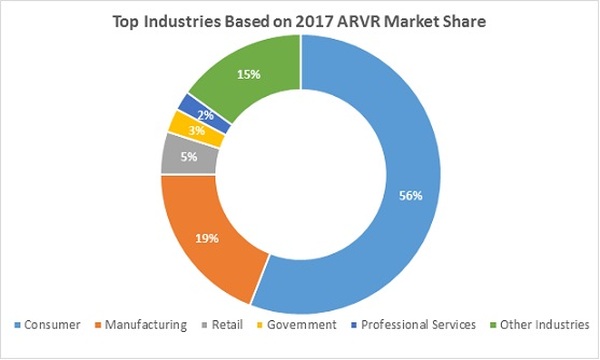
The Worldwide Semiannual Augmented and Virtual Reality Spending Guide update, recently released by International Data Corporation (IDC), forecasts Western European revenues for the augmented reality and virtual reality (AR/VR) market to reach $2.5 billion in 2017, showing a 131% increase over the $1.1 billion spent in 2016. AR/VR spending will further accelerate in the coming years, achieving a compound annual growth rate (2015-2020 CAGR) of 210% and totaling $25.7 billion in 2020. “These kinds of devices have been around for a while; but now we are seeing the right combination of content, components, investment and…

Read More

Comments & opinions 

Making sure systems “do the right thing”

AI is fascinating but is not an end in itself. Developers are looking for ways to sensibly incorporate the technology. Modern learning algorithms, such as deep neural networks, are able to autonomously solve highly complex tasks – with nearly human precision. Up to this point, however, these intelligent algorithms are black boxes. No one knows why they make the decisions they do and why they at times fail. With Transparent AI , the Fraunhofer Institute for Telecommunications, Heinrich Hertz Institute, HHI in Hall 6 is presenting a general tool that allows users…

Read More
Analysis 

Spending on the Central and Eastern Europe Mobility Market Will Reach $64.7 Billion in 2020, According to IDC 

According to the recently issued Worldwide Semiannual Mobility Spending Guide, International Data Corporation (IDC) forecasts a stable consumer and enterprise mobility market in the Central and Eastern Europe (CEE) region over the 2016-2020 period. Total CEE market revenue is expected to increase from $60.9 billion in 2016 to $64.7 in 2020, reflecting a 1.4% compound annual growth rate (CAGR). Connectivity services will represent the largest category of mobility spending over the forecast period, with a slightly decreasing share of the overall market. Hardware investments will contribute over 36% to mobility spending,…

Read More
Comments & opinions 

Transform your business into a Digital War Machine

Digital technologies have impacted or rather have shaken up the majority of the industries today. Digital businesses have shown potential to save costs, redefine value chains and they even allow us to work and collaborate in new ways. One of the main benefits of a true digital business is that it leverages technologies that will allow it to produce value at almost no cost and equally distribute that value at not cost either. These are good pre-requisites for rapid growth. But what is a digital business and what are the…

Read More
Comments & opinions 

What does a CTO do?

This is a question that I sought out to find an answer for in early 2012 when I became full time CTO at Cloudera. I did a bunch of online research and talked to a number of enterprise software CTOs whom I look up to (listed at end). I summarize my findings by answering four core questions: What is the CTO Mission? How to measure the CTO? How should the CTO split his/her time internally vs externally? What are the specific responsibilities of the CTO towards the main constituents inside…

Read More
News 

New Reference Architecture is a Leap Forward for Fog Computing

On February 8th, the OpenFog Consortium released the OpenFog Reference Architecture (RA).  This 162 page document represents more than a year’s work from our global membership of 55 organizations. The OpenFog RA is a mid-level guidepost document, full of invaluable architecture recommendations for anyone wishing to implement fog components, fog nodes, entire fog networks, or fog-based applications.  It describes in detail several illustrative fog use cases in transportation, smart cities, and visual security. The RA also discusses eight core fog capabilities that we call the Pillars of OpenFog, including Security, Scalability, Openness, Autonomy, Manageability, Agility,…

Read More
Comments & opinions 

What is SSL and why it affects website ranking?

You’ve probably seen that some URLs start with “http://”, while other start with “https://”. Https is usually part of your banks or your favorite web shops URL, right? What does that “s” after http mean and why some websites have it while others don’t? In this case “s” stands for Secure and it means that communication with that website is secured, i.e. safe. What stands behind https is technology called Secure Socket Layer, better known by its acronym SSL. Who need SSL and why? SSL is used for safe transfer…

Read More
Comments & opinions 

Unmanned systems take on big city darkness

Drones from Globe UAV GmbH use the high-speed 4G LTE wireless Internet. Control data and live video feeds are transmitted in real time. The wireless LTE standard supports data transmissions of up to 100 MBit/s. In highly populated areas this high speed network has hardly any gaps. In the countryside on the other hand, high speed surfing is not standard at all. For Globe UAV GmbH’s drones this means that they are mostly deployed in cities since the control data and live video feed that they can transmit bi-directionally in…

Read More
Analysis 

Big Data, Analytics and Industry 4.0

Big data is an idiom which describes the huge volume of data (includes both structured & unstructured) that engulf a business during its various operational transactions. It has long been a buzzword in various IT strategic discussions & board rooms of many organizations. Big data can be analysed for making various strategic decisions (i.e. E-commerce companies making the availability/optimization of their stocks based upon the prophecy from social media), improving health care (i.e. Apples health App, by which one can collect data from users phone to study the health related…

Read More
Analysis 

IDC Predicts Lively IT Spending Growth in Central and Eastern Europe, Driven by Government and Finance Verticals

According to the Worldwide Semiannual IT Spending Guide: Industry and Company Size published by International Data Corporation (IDC), overall IT market spending is forecast to grow in Central and Eastern Europe (CEE), with the government and finance sectors showing the greatest year-on-year spending increase. IDC forecasts that IT spending (hardware, software, and services combined) in the CEE region will reach $62.58 billion in 2017. By 2020, it is expected to exceed $70.58 billion. In the public sector, growth is being driven by digital transformation projects such as egovernment and smart cities solutions.…

Read More
error: https://exclusivenews.ogledalo.rs- Content is protected !!